
Day of The Dead
Día de los Muertos ("Day of the Dead") is a Mexican tradition that celebrates and honors the lives of family members and loved ones who have died. Rather than focusing on grief, it is a time of remembrance, reunion, and celebrating the enduring bond between the living and the dead.
A central belief in many traditions surrounding Día de los Muertos is that the spirits of deceased loved ones return to visit during these days. Cempasúchil (marigolds) with their bright orange color and fragrance are believed to help guide the spirits back to their families. Ofrendas (altars) are decorated at home with photographs, candles, marigolds, incense, favorite foods, drinks, and personal belongings of those being remembered. Decorated calaveras (sugar skulls) represent the continuity of life and the acceptance of death as a natural part of existence.


Breakdown
Developed high-quality 3D assets through the complete digital content creation (DCC) pipeline, leveraging industry-standard software for modeling, sculpting, texturing, lighting, look development, rendering, and real-time visualization. Produced production-ready environments, props, and digital assets optimized for visual effects, animation, games, and virtual production workflows.

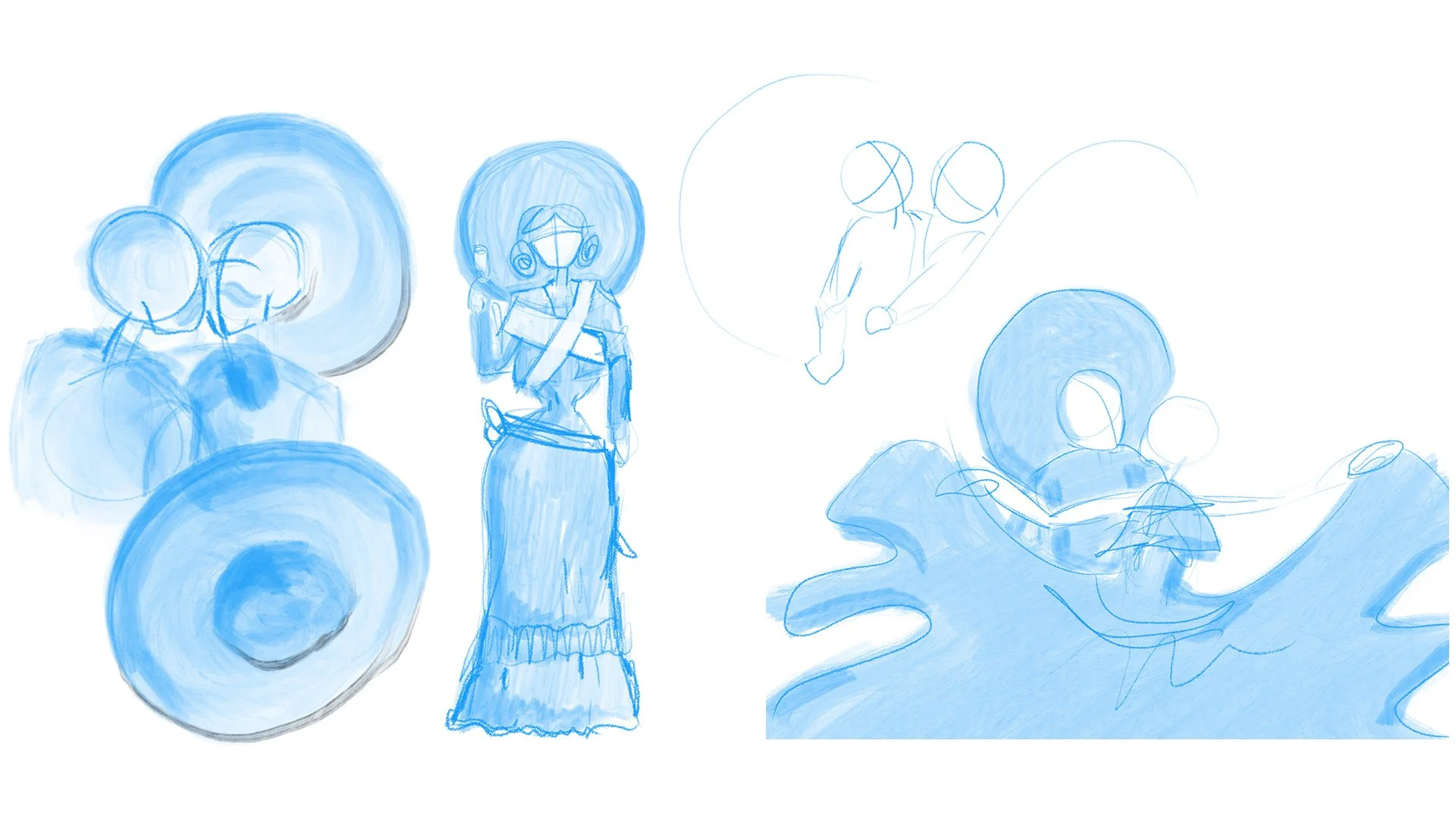
Concept
Rough illustrations were created to explore and communicate the look, feel, design, props, and silhouette before refinement. Once a clear visual direction for the project has been established 3D assets were modeled for production.
La Adelita
The Adelitas were the women who participated in the Mexican Revolution (1910–1920), a period of political and social upheaval that transformed Mexico. The name is often used broadly for the women who supported revolutionary armies, especially those known as soldaderas—women who traveled with military forces and contributed as fighters, nurses, cooks, messengers, suppliers, and organizers.


Utilized Autodesk Maya for modeling, scene assembly, and animation; Blender for asset creation and procedural workflows; ZBrush for high-resolution digital sculpting; Adobe Substance 3D Painter and Designer for physically based (PBR) material authoring and texture creation; and Adobe Photoshop for texture refinement and compositing support. Built cinematic lighting and look development using RenderMan and Unreal Engine 5, balancing visual fidelity with rendering performance.
To accurately represent traditional Mexican attire, the digital garments were meticulously developed through a VFX character asset pipeline, combining digital sculpting, cloth simulation, and garment modeling techniques to achieve authentic fabric construction, silhouette, and material behavior. Cultural accurate clothing assets were created with realistic folds, seams, stitching, layering, and surface characteristics to replicate the physical properties of traditional textiles.
El Charro
Garment topology and UV layouts were carefully refined to support high-resolution texturing, physically based shading, and realistic deformation for animation, motion capture, and performance capture workflows. Fabric materials were were textured and shaded using physically based rendering (PBR) workflows, including color, roughness, normal, and displacement maps, resulting in production-ready digital costumes optimized for cinematic rendering and real-time virtual production environments.


Environment
The modeling process began with reference analysis, concept interpretation, and blockout development to establish accurate scale, silhouette, and primary forms. Assets were refined through subdivision modeling, Boolean workflows, and precision-based polygon modeling techniques to achieve clean, high-resolution geometry with controlled edge flow and realistic manufacturing details.
High-resolution models were optimized through retopology, mesh cleanup, and polygon reduction workflows to create efficient production-ready assets. UV layouts were generated with proper texel density and minimal distortion, enabling seamless texturing and material development.


2D Imagery to 3D Model
The kiosk’s rails, panels, and accent decor were digitally drawn in 2D then converted into a 3D asset by developing a high-density mesh and applying displacement modifier workflows to generate surface depth and geometric detail. Height maps were utilized to drive vertex displacement, creating realistic surface variations while maintaining procedural control over the asset. The model was further refined through UV unwrapping, texture projection, material authoring, and look development for final rendering.
